January 2026
Welcome to our first ever Natural Surroundings Gardens and Reserve Roundup of News. This is where we can share with you the comings and goings, the highs and the lows of our day.
After the new year plant hunt on the 2nd January (details here), 2026 began with a stiff north westerly wind, which means cold here in our position on the side of the River Glaven valley. There is not much to shelter us from any 'weather' from the north or north-west. The vast majority of our plants are hardy but a bitter north-westerly can damage a few precious plants, such as Daphne bholua 'Jacquline Postill' and the rather delicate rosemary 'Benenden Blue'. The daphne, complete with it's wonderful scent, was moved this spring and needed some extra protection to prevent wind rock. The flowers have opened white, I'm sure it was pink before. The rosemary is a rather special one, purchased from Great Dixter House and Gardens in East Sussex many years ago. Recently I have been reading the unexpectedly wonderful book about Collingwood 'Cherry' Ingram', the man who saved the 'Tai-haku' cherry (we have this tree planted in the woodlands). The book, 'Cherry' Ingram The Englishman Who Saved Japan's Blossoms by Naoko Abe (2019), came highly recommended by a regular visitor to the gardens. I read that Collingwood Ingram lived in Benenden in Kent and this rosemary was named by him from plants collected in Corsica. I love a connection to plants and it makes them special.
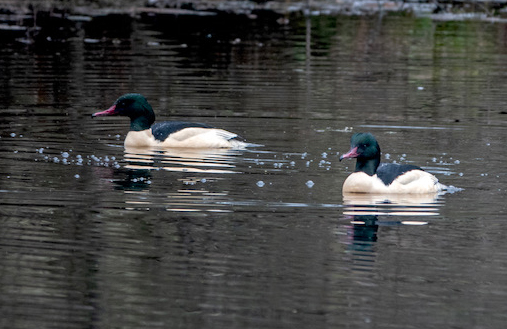
The numbers of birds visiting our feeders outside the cafe is highest in mid winter. Mostly Blue Tit, Great Tit and Coal Tit with gangs of Goldfinches, Long-tailed Tits, as well as Nuthatch and Great-spotted Woodpecker. We have not seen Marsh Tit for a while nor Siskin or Brambling this winter. Away from the feeders there are plenty of Siskins whirling around the trees in the woods and ravens call as they fly over. Snipe have been seen in the meadows and Woodcock flushed occasionally from the woods. There are very few berries around the gardens and reserve now, an influx of Blackbirds having taken all but a few rose hips and hawthorn haws. For a few weeks there were two stunning male Goosanders on Bayfield lake, they moved off when the lake froze over, but at least one has returned.
The muddy and occasionally snowy weather means mammal tracks are easily seen. We keep a solid eye on the Muntjac who love to nibble the plants, usually those we would really rather they didn't. Red Deer have been evident too and there are always Otter prints to be found in the mud by the river. Another mammal that causes us serious grief is the Mole - always in evidence but in winter they seem hell bent in turning up every inch of soil.
With no leaves on the trees we notice how much more lichen is evident and on fallen twigs the rich colours really show themselves. Always drawn to pick some up, on several occasions I have spotted very, very small snails, miniature versions of a pond snail that you really need a hand lens to see well. These are one of several tiny snail species to look out for - on trees and amongst moss or rotten vegetation, generally in damp areas.
We have been busy with the help of our Thursday Garden Club volunteers, cutting and grading the osier willow for use in workshops and around the gardens. Cutting in January, does remove this year's catkins but we have a wide range of other willow species here and many of these have the most lovely catkins. Simon is leading a walk to help you identify trees in winter on Saturday 14th February - many of these will look beautiful then.
Anne Harrap
February 2026
February has been memorable for dull, wet days, some decidedly chilly and others very mild, but overall with very few days with any sun. There is always plenty to do and towards the end of the month with the days noticeable longer we have flowers to look at and emerging plants to spot. We have been coppicing much hazel this year with help from the Thursday Garden Club volunteers. The willow and hazel hurdles we use for fencing are slowly being replaced by new ones and it is wonderful to be able to use material grown and cut on site. A new fence is in place around the woodland edge, protecting the Fern & Fungi Garden from Muntjac. We expect the ferns to look stunning this year. The fence here is in a style we saw around gardens in Romania while visiting the meadows at Viscri. Very few nails or screws are needed and the hazel uprights are just woven through the horizontals. Simon's gates finishes it off beautifully.
Snowdrops, Winter Aconites and hellebores have been a feature of the gardens this month. The Snowdrops are mostly Galanthus nivalis but in the gardens we also have G. plicatus 'Warham' and G. elwesii. We will be dividing and replanting some of the larger clumps once the flowers have faded.
Several compost bins have been emptied and the contents spread over the gardens this month. Despite all the rain as much of our gardens are very free-draining they are prone to drying out and we hope a good layer of mulch now will help the plants through any summer droughts without too much extra water.
We had a visit from the Plant Heritage team who are planning a display for the RHS Sandringham Show in July. We talked about our National Collection of Gunnera and discussing which ones would be making an appearance at the show on the Plant Heritage stand - we are waiting to see their final design.

Alder Cup

The slime mould Criterium minutum
The woodland beside the river has been very wet and the paths muddy but those who ventured in and kept a keen lookout may have spotted many small cup fungi amongst the leaf litter. These are the aptly named Alder Goblet, Ciboria caucus, whose fruiting bodies emerge from two-year-old rotting male alder cones! Another find was tiny fruiting bodies clustered over a some old plastic mesh in the nursery. On closer examination we decided that they are most likely the slime mould Criterium minutum. The curiosities came in threes. At the end of the month, a strange soft, very black, pillowy brain-like mass extruded from one of our benches. This is most likely to be a fungus with a lovely name - Warlock's butter Exidia nigricans.
Anne Harrap